POCO X8 Pro Max Review: 8500mAh Battery, Dimensity 9500s and 100W Charging
The POCO X8 Pro Max has one very obvious goal: give you as much phone as possible without jumping into ultra-expensive flagship territory.
And POCO didn’t hold back.
We’re talking about an 8,500mAh battery, 100W charging, a 6.83-inch 120Hz AMOLED display, the MediaTek Dimensity 9500s, UFS 4.1 storage and a 50MP main camera with OIS.
The numbers are big. Very big.
But after looking past the spec sheet, there are some compromises you should know about before buying one.
POCO X8 Pro Max: Key Specifications
Specification POCO X8 Pro Max
Display 6.83-inch AMOLED
Resolution 2772 × 1280
Refresh rate 120Hz
Processor MediaTek Dimensity 9500s
Process 3nm
RAM 12GB LPDDR5X
Storage 256GB / 512GB UFS 4.1
Main camera 50MP Light Fusion 600, OIS
Ultra-wide 8MP
Selfie camera 20MP
Battery 8,500mAh
Charging 100W
Reverse charging Up to 27W
Software Android 16 / HyperOS 3
Fingerprint Ultrasonic
Water resistance IP68
Weight 218g
Thickness 8.2mm
POCO officially lists 12GB RAM with 256GB or 512GB storage, while the phone measures 162.9 × 77.9 × 8.2mm and weighs 218g.
Design: Big Phone, Surprisingly Reasonable Weight
The first thing you’ll notice is the size.
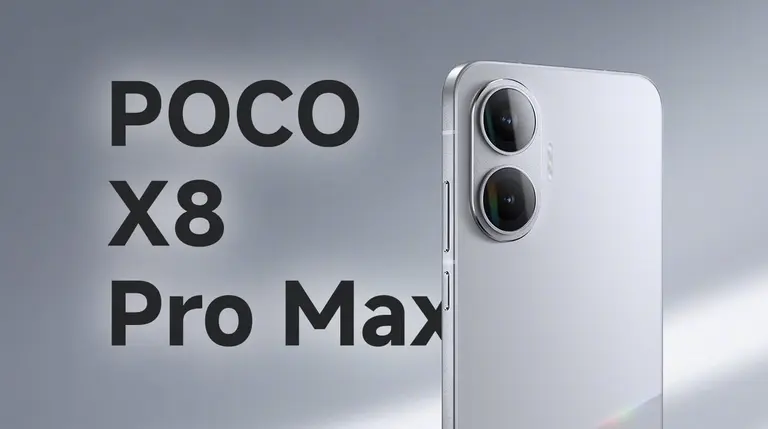
The X8 Pro Max measures 162.9mm tall and 77.9mm wide, with a thickness of 8.2mm. Yet POCO has managed to keep the weight at 218g despite putting an enormous battery inside.
That’s impressive.
Don’t misunderstand me, though. This isn’t a compact phone. If you have small hands, one-handed use will still be a stretch.
POCO gives the X8 Pro Max a more polished design than some of its older performance-focused phones. There’s also an IP68 rating, which gives you much better protection against dust and water than budget phones typically offer.
Just don’t confuse IP68 with waterproofing. POCO’s certification is based on specific laboratory conditions, including static freshwater immersion up to 2 meters for 30 minutes.
Display: One of the Phone’s Best Features
The X8 Pro Max gets a 6.83-inch 1.5K AMOLED display with a 120Hz refresh rate.
The resolution is 2772 × 1280, and POCO claims up to 3,500 nits peak brightness when 25% of the display is illuminated. Typical brightness is listed at 800 nits, with HBM reaching 2,000 nits.
In everyday use, that should make the phone comfortable for watching videos, gaming and scrolling.
You also get 12-bit color, Dolby Vision, HDR10+, DCI-P3 and 3840Hz PWM dimming.
The bezels are impressively slim, too. POCO claims a 94.27% screen-to-body ratio, with 1.5mm bezels on three sides and a 1.78mm bottom bezel.
The catch?
The screen is large enough to make the phone feel large.
That’s great for gaming. It’s great for Netflix. It’s less great when you’re trying to type with one hand while walking around.
Performance: Dimensity 9500s Does the Heavy Lifting
This is where the X8 Pro Max gets interesting.
POCO uses the MediaTek Dimensity 9500s, manufactured on a 3nm process. The chip uses an all-big-core CPU design with a maximum clock speed of 3.73GHz and an Immortalis-G925 GPU.
POCO quotes an AnTuTu V11 score of 3,085,998.
That’s an impressive number, although you shouldn’t treat any manufacturer’s benchmark result as a guarantee of what you’ll see on your own device. POCO says its result was measured internally using AnTuTu V11.0.5 at around 25°C.
The memory setup is also properly fast:
LPDDR5X at 9600Mbps
UFS 4.1 storage
12GB RAM
256GB or 512GB storage
That combination should make app launches, multitasking and large game installations feel snappy.
Gaming: This Is Where POCO Wants Your Attention
POCO has put serious effort into cooling.
The X8 Pro Max uses a 3D IceLoop cooling system with a 5,800mm² liquid heat-pump area and an 11,000mm² graphite layer. POCO says the system can reduce SoC temperatures by up to 3°C under its test conditions.
There’s also WildBoost Optimization, which is designed to predict frame demand and help prevent frame-rate drops during heavy gaming.
In POCO’s one-hour RPG test, the X8 Pro Max averaged 60.17fps and recorded 55.41fps for its 1% low frame rate, with a maximum temperature of 41.8°C at 25°C ambient temperature.
Those are promising numbers.
But remember, they’re POCO’s own laboratory results. Your temperature and frame rate can be different depending on the game, room temperature, brightness and network conditions.
Still, this is clearly a phone built with gamers in mind.
Battery: The 8,500mAh Monster
This is the headline feature.
The POCO X8 Pro Max has an 8,500mAh silicon-carbon battery with 16% ultra-high silicon-carbon content and 847Wh/L energy density.
That’s enormous for a mainstream smartphone.
POCO claims the phone can deliver a simulated two-day battery life, with internal testing showing more than 74 hours of calling, over 16 hours of video calling and more than 15 hours of gaming.
Obviously, your mileage will vary.
But even if real-world use falls well short of those laboratory figures, an 8,500mAh battery gives the X8 Pro Max a huge endurance advantage.
100W Charging Helps Solve the Biggest Battery Problem
A huge battery sounds great until you remember that huge batteries take longer to charge.
POCO’s solution is simple: 100W HyperCharge.
The company says the X8 Pro Max can reach 50% charge in around 24 minutes, under its specified conditions. It also supports the 100W PPS universal charging protocol.
There’s support for up to 27W wired reverse charging, too.
That’s useful when your earbuds, smartwatch or another phone needs a quick top-up.
One thing to remember
Maximum charging speed isn’t guaranteed all the time.
Charging speed depends on factors such as temperature, battery level and usage. POCO’s smart charging system adjusts power based on those conditions.
And yes, fast charging creates heat. That’s simply part of the physics.
Camera: Good Main Sensor, But Don’t Expect a Camera Phone
The rear camera setup is straightforward.
You get:
50MP Light Fusion 600 main camera
f/1.5 aperture
1/1.95-inch sensor
OIS
8MP ultra-wide
The front camera is 20MP.
The main camera is the one I’d pay attention to.
The large f/1.5 aperture and OIS give it a solid hardware foundation, particularly for night shots and moving subjects.
But here’s where POCO makes a clear compromise.
There is no dedicated telephoto camera.
If you’re serious about zoom photography, this isn’t going to compete with phones that have proper optical telephoto lenses.
The 8MP ultra-wide is another obvious cost-saving decision. Eight megapixels isn’t terrible, but it’s well below what you get from more expensive camera-focused phones.
Video Recording
The main camera can record:
4K at 30fps
4K at 60fps
1080p at 30fps
1080p at 60fps
Slow motion at up to 960fps in supported modes
The front camera supports 1080p video at 30fps and 60fps.
That’s perfectly respectable.
But if camera quality is your number-one priority, I’d spend more money elsewhere.
The X8 Pro Max is designed to be a performance and battery phone first, not a camera flagship.
Software: Android 16 and HyperOS 3
The X8 Pro Max runs Android 16 with HyperOS 3.
You’ll get Xiaomi’s familiar software experience, including customization options and a range of AI features.
POCO lists features such as Google Gemini, Circle to Search, AI Writing, AI Speech Recognition, AI Interpreter, AI Search and AI Creativity Assistant.
The catch is that AI features aren’t universally available.
POCO specifically notes that availability can depend on region, language, device model and software version.
So don’t buy the phone solely because of an AI feature you saw in a promotional video.
Ultrasonic Fingerprint Sensor
Here’s another nice upgrade.
The X8 Pro Max gets an ultrasonic fingerprint sensor rather than a basic optical in-display sensor.
POCO says it supports wet-hand unlocking and uses a press-and-slide enrollment process designed to make setup faster.
This is one of those features that sounds minor but makes the phone feel more premium every time you unlock it.
Speakers and Multimedia
The phone uses symmetrical stereo speakers with dual 1115F speaker units.
POCO claims up to a 400% volume boost compared with the same model at 100% volume in its specified scenario.
The combination of a large 6.83-inch AMOLED display and stereo speakers makes the X8 Pro Max a strong entertainment device.
For YouTube, Netflix and gaming, this is arguably more important than having another few megapixels on the camera.
POCO X8 Pro Max Pros and Cons
What I Like
8,500mAh battery is seriously huge
100W fast charging
Dimensity 9500s provides flagship-level performance potential
120Hz 1.5K AMOLED display
3,500-nit peak brightness claim
UFS 4.1 storage
LPDDR5X RAM
Ultrasonic fingerprint sensor
IP68 protection
Strong cooling system
Stereo speakers
Android 16 with HyperOS 3
What I Don’t Like
218g is still heavy
6.83-inch screen makes one-handed use difficult
Only an 8MP ultra-wide camera
No dedicated telephoto camera
Camera system isn’t the phone’s main strength
Maximum charging performance depends on conditions
Some AI features vary by region
POCO’s benchmark and battery claims are internal figures
POCO X8 Pro Max: Who Should Buy It?
The answer is pretty simple.
Buy it if you want battery life and performance above almost everything else.
This is a particularly interesting phone for gamers, heavy users, commuters and people who simply hate charging their phone every evening.
The combination of an 8,500mAh battery and 100W charging is difficult to ignore.
The Dimensity 9500s also gives the phone enough horsepower to handle demanding games and heavy multitasking without making the battery capacity feel pointless.
Who Should Skip It?
I’d look elsewhere if you care most about photography.
The 50MP main camera is respectable, but the 8MP ultra-wide and lack of a telephoto camera reveal where POCO has saved money.
I’d also think twice if you dislike big phones.
The 6.83-inch display is fantastic for media, but it’s not exactly pocket-friendly.
POCO X8 Pro Max vs a Typical Flagship
This is where the X8 Pro Max becomes interesting.
A conventional flagship may give you a better camera system, more polished software or a lighter design.
But the POCO fights back with sheer hardware.
Feature POCO X8 Pro Max
Battery 8,500mAh
Charging 100W
Display 6.83-inch 120Hz AMOLED
Processor Dimensity 9500s
Storage UFS 4.1
Fingerprint Ultrasonic
Water resistance IP68
Main camera 50MP OIS
Telephoto No
That tells you exactly what kind of phone this is.
It’s a power user’s phone first.
POCO X8 Pro Max Price and Value
The POCO X8 Pro Max launched at $469 / £469 for 12GB + 256GB, while the 12GB + 512GB version launched at $519 / £519 in markets where those prices apply.
At that level, the value proposition is aggressive.
You’re getting hardware that, feature for feature, can look closer to a premium phone than a conventional mid-range device.
Local pricing can be very different, though, especially once taxes, import costs and retailer margins are added.
Final Verdict
The POCO X8 Pro Max is a very easy phone to understand.
It isn’t trying to win every category.
It wants to give you huge battery life, fast charging, serious performance and a big, bright display.
And it does exactly that.
The 8,500mAh battery is the star. The Dimensity 9500s is the muscle. The 120Hz AMOLED display ties the package together.
The compromises are mostly around the cameras and size.
If you want the best camera phone in this price range, look elsewhere. If you want a compact phone, definitely look elsewhere.
But if your reaction to a 6.83-inch display, 8,500mAh battery and 100W charging is “that’s exactly what I want,” then the POCO X8 Pro Max makes a lot of sense.
It’s not the most balanced phone in its class. It’s the phone that goes hardest at the things power users care about.
And honestly, that’s what makes it interesting.
Suggested SEO title: POCO X8 Pro Max Review: 8500mAh Battery, Dimensity 9500s & 100W Charging
Suggested meta description: POCO X8 Pro Max review covering its 8500mAh battery, Dimensity 9500s performance, 100W charging, 120Hz AMOLED display, cameras, gaming and price.