POCO C71 Review: A Big 120Hz Screen and Huge Battery at a Budget Price
The POCO C71 is the kind of phone that makes sense when your budget is tight. It doesn’t try to compete with expensive phones on cameras or charging speed. Instead, POCO focuses on the things that matter most for everyday use: a big screen, a large battery, expandable storage and a reasonably modern Android experience.
I’ve looked at the C71 from the perspective that matters for a budget phone: how it actually feels to use, not just how impressive the spec sheet looks.
And there are some compromises you should know about.
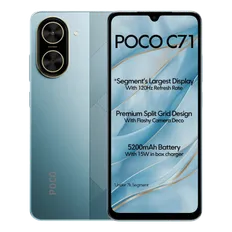
POCO officially lists the C71 with a 6.88-inch 120Hz display, Unisoc T7250 chipset, 32MP rear camera, 8MP selfie camera and a 5,200mAh battery.
POCO C71 Specs at a Glance
Specification POCO C71
Display 6.88-inch IPS LCD
Resolution 1640 × 720
Refresh rate Up to 120Hz
Processor Unisoc T7250
RAM 4GB / 6GB
Storage 64GB / 128GB
microSD Yes
Rear camera 32MP
Selfie camera 8MP
Battery 5,200mAh
Charging 15W
Software Android 15 (Go Edition)
Network 4G LTE
Fingerprint Side-mounted
Headphone jack Yes
USB USB-C
The exact memory configurations and availability can vary by market. POCO’s global specifications confirm the 32MP rear camera, 8MP selfie camera and 5,200mAh battery.
Design: Surprisingly Good for a Cheap Phone
This is one area where the C71 punches above its class.
The rear has a distinctive two-tone design rather than the plain plastic finish we’ve seen on countless entry-level phones. It doesn’t look like an expensive flagship, but it doesn’t scream “cheap phone” either.
The phone weighs around 193 grams and is about 8.3mm thick.
I also like the side-mounted fingerprint reader. It’s quick enough for everyday unlocking and is placed exactly where your thumb naturally lands.
There is basic IP52 dust and splash resistance on the C71, but don’t mistake that for waterproofing. This is still a phone you should keep away from serious water.
Display: 120Hz Is the Star
The 6.88-inch LCD is massive for this price category.
You get a 1640 × 720 resolution and refresh rate of up to 120Hz. Scrolling through social media and moving around the interface feels noticeably smoother than a conventional 60Hz budget phone.
But there’s a catch.
It’s still an HD+ panel.
At 6.88 inches, the relatively low pixel density is noticeable if you look closely. Text and fine details aren’t as crisp as they are on a Full HD display.
Brightness is another weak point. POCO lists 450 nits typical brightness, while HBM figures can reach around 600 nits depending on the measurement and mode.
In direct Pakistani sunlight, I’d expect you to struggle more than you would with a brighter mid-range phone.
So, the verdict is simple: great size and refresh rate, average resolution and outdoor visibility.
Performance: Good for the Basics
The C71 uses the Unisoc T7250, with CPU speeds up to 1.8GHz. POCO says its performance is substantially ahead of the previous C61, although its own benchmark figures should be treated as manufacturer testing rather than independent results.
For normal use, that’s what this phone is really designed for.
WhatsApp
YouTube
Facebook
Instagram
Web browsing
Music streaming
Light multitasking
Those tasks are within its comfort zone.
But don’t buy the C71 expecting gaming-phone performance.
Heavy games will require reduced graphics settings, and you can expect occasional stutters when the phone is pushed hard. Independent reviews also found everyday performance somewhat underwhelming compared with faster alternatives.
For basic use: fine. For serious gaming: look elsewhere.
Software: One of Its Better Features
The C71 ships with Android 15 (Go Edition).
That’s important because Go Edition is designed for lower-powered hardware and lighter resource usage.
POCO also advertises memory expansion, allowing the 4GB RAM model to use additional storage as virtual memory. Just remember that virtual RAM isn’t the same thing as having more physical RAM.
The overall experience is reasonably clean for an entry-level phone, although you shouldn’t expect the speed or multitasking ability of a more expensive POCO or Redmi device.
Cameras: Don’t Buy It for Photography
The rear camera is a 32MP main sensor, paired with an auxiliary lens. There’s an 8MP camera on the front. Both cameras support 1080p video at 30fps.
On paper, 32MP sounds impressive.
In practice, this is still a budget camera system.
In good daylight, you can get usable social-media photos. But dynamic range, fine detail and low-light performance aren’t going to compete with phones costing considerably more.
Independent testing has also flagged the cameras as one of the C71’s weaker areas.
The camera is good enough for WhatsApp and casual snapshots. It isn’t a reason to buy this phone.
Battery Life: The C71 Gets This Right
The 5,200mAh battery is probably the phone’s strongest practical feature.
POCO claims up to 20 hours of video playback, 28 hours of calling and 108 hours of music playback under its internal testing conditions. Real-world results will obviously vary.
In independent testing, the C71 delivered strong battery endurance, including a PCMark battery result of 13.7 hours.
For a typical user, a full day should be comfortable.
Light users may stretch it beyond that.
The problem comes when you need to refill the battery.
Charging: This Is the Annoying Part
The C71 supports only 15W charging.
That’s slow by today’s standards.
One independent test found that charging from 20% to 100% took roughly 120 minutes.
So yes, the battery lasts well.
But when it finally runs low, you’ll need patience.
Big battery: excellent. Charging speed: mediocre.
POCO C71 Pros and Cons
What I Like
Huge 6.88-inch display
Smooth 120Hz refresh rate
Large 5,200mAh battery
USB-C charging
Side-mounted fingerprint scanner
microSD card support
3.5mm headphone jack
Android 15 Go Edition
Distinctive design
Basic IP52 protection
What I Don’t Like
720p resolution looks soft on such a large screen
15W charging is slow
Camera quality is average
No 5G
Performance isn’t aimed at serious gaming
Outdoor screen visibility could be better
Single-speaker setup isn’t particularly impressive
POCO C71 Price in Pakistan
This is where things get tricky.
Current Pakistani listings aren’t consistent. Some sources list the C71 around Rs. 20,999–29,999, while another current listing puts the expected price around Rs. 24,999 and notes that official Pakistani launch status may vary.
So I wouldn’t treat every online “POCO C71 price in Pakistan” figure as an official price.
If you’re buying one, check the seller, official warranty and exact RAM/storage configuration before paying.
POCO C71: Should You Buy It?
The POCO C71 isn’t trying to be an all-round champion.
It’s a budget phone built around a few smart priorities.
You get a huge 120Hz display, a big battery, expandable storage and modern Android software. Those are genuinely useful features if you’re buying your first smartphone or simply don’t want to spend much money.
But the weaknesses are equally clear.
The HD+ display isn’t especially sharp. The cameras are nothing special. Charging is slow. And the Unisoc processor isn’t something I’d choose for demanding gaming.
My Verdict
Buy the POCO C71 if: you want a large, smooth display, strong battery life and basic everyday performance at a low price.
Skip it if: you care about photography, fast charging, 5G or demanding gaming.
For the right price, the POCO C71 is a sensible entry-level smartphone rather than a spectacular one. And honestly, that’s perfectly fine. At this end of the market, getting the basics right matters more than chasing flashy specifications.
Overall: 7/10
The C71 is a phone I’d recommend to a budget buyer who knows exactly what they’re getting. Just don’t let the 120Hz display and 32MP camera numbers convince you that this is something it isn’t.