POCO F8 Ultra Review: A True Flagship Killer or Just Another Fast Phone?
The POCO F8 Ultra is not trying to be a modest upgrade.
POCO has gone all-in this time: a Snapdragon 8 Elite Gen 5 chip, a 6.9-inch 120Hz AMOLED display, a 6,500mAh silicon-carbon battery, 100W wired charging, 50W wireless charging, and — finally — a proper 5x periscope camera.
That combination makes the F8 Ultra one of the most interesting performance-focused phones in POCO’s lineup.
The real question is whether POCO has fixed the compromises that usually come with aggressive pricing.
Let’s break it down.
POCO F8 Ultra: Key Specifications
Specification POCO F8 Ultra
Display 6.9-inch AMOLED, up to 120Hz
Resolution 2608 × 1200
Processor Snapdragon 8 Elite Gen 5
RAM 12GB / 16GB LPDDR5X
Storage 256GB / 512GB UFS 4.1
Main camera 50MP Light Fusion 950, OIS
Telephoto 50MP 5x periscope, OIS
Ultra-wide 50MP
Selfie camera 32MP
Battery 6,500mAh
Wired charging 100W
Wireless charging 50W
Software Xiaomi HyperOS 3
Fingerprint sensor Ultrasonic in-display
Water resistance IP68
Weight 218g–220g
Speakers Stereo + independent subwoofer, Sound by Bose
These are official specifications from POCO/Xiaomi.
Design: Finally, a POCO That Feels More Expensive
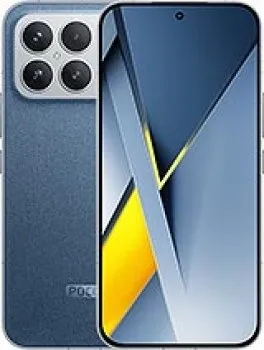
The F8 Ultra takes a more premium approach than the stereotypical gaming-focused POCO phone.
It comes in Black and Denim Blue, with POCO using glass-fiber construction for the black version and a textured nano-tech material for Denim Blue. The company also uses a one-piece milled glass back design.
The phone weighs around 218g in black and 220g in Denim Blue.
That’s not lightweight.
The 6.9-inch screen also makes the F8 Ultra a large phone. If you prefer compact flagships, this isn’t going to magically change your mind.
The upside is obvious: that large chassis gives POCO room for a huge battery, powerful cooling hardware and a large display.
My biggest concern here is ergonomics. A phone this big and heavy can become tiring during long gaming sessions, especially if you’re using it with one hand.
On the other hand, the IP68 rating is a welcome addition. POCO specifies laboratory resistance to dust and fresh-water immersion under particular conditions, so don’t treat the rating as permission to take the phone swimming.
Display: 6.9 Inches of Serious Screen
The F8 Ultra has a 6.9-inch AMOLED display with a 2608 × 1200 resolution and a refresh rate of up to 120Hz. It also supports HDR10+ and Dolby Vision.
On paper, this is an impressive panel.
POCO claims up to 3,500 nits peak brightness, although that figure applies to a 25% display area. High-brightness mode is rated at up to 2,000 nits, while typical brightness is listed at 600 nits.
There’s also 12-bit color support, DCI-P3 coverage, DC dimming and several TÜV Rheinland eye-care certifications.
One feature I particularly like is Wet Touch Display 2.0. That’s the kind of small feature you don’t think about until you’re trying to use your phone with damp fingers.
POCO is also pushing its HyperRGB display technology, with a redesigned panel intended to improve efficiency and visual clarity.
The catch?
It’s still a very large screen.
If you’re watching Netflix, gaming or editing photos, that extra real estate is excellent. If you’re carrying the phone around all day, however, the size is harder to ignore.
Performance: This Is the Main Event
This is where the POCO F8 Ultra gets serious.
Inside is Qualcomm’s Snapdragon 8 Elite Gen 5, built on a 3nm process. The CPU uses a 2+6 all-big-core architecture, with maximum clock speeds exceeding 4.6GHz.
Memory isn’t an afterthought either.
You get LPDDR5X RAM and UFS 4.1 storage, with configurations reaching 16GB RAM and 512GB storage.
POCO quotes an AnTuTu V11 score of 3,944,934 from its internal testing.
That number sounds ridiculous.
But remember: benchmark scores aren’t the same thing as everyday performance. Your actual result will depend on software, temperature, battery level, background processes and benchmark conditions.
Still, the hardware leaves very little doubt about what this phone is designed for.
Gaming. Heavy multitasking. Emulation. Video editing. Sustained high-performance workloads.
The F8 Ultra also includes the VisionBoost D8 chipset, which POCO says handles graphics enhancement, AI super-resolution and frame interpolation. The company claims its technology can interpolate supported games to 120fps.
That sounds great, but frame interpolation isn’t the same thing as a game actually rendering 120 native frames per second.
That’s an important distinction.
Gaming: A Lot of Hardware for the Money
The F8 Ultra looks built for people who actually push their phones.
The Snapdragon 8 Elite Gen 5 provides the horsepower, while POCO’s VisionBoost D8 chip is designed to assist with graphics processing and frame interpolation.
POCO also highlights real-time multi-surface temperature monitoring for more precise thermal management.
That’s encouraging because performance is easy to advertise; sustained performance is harder.
A phone can deliver a spectacular benchmark result for five minutes. The interesting test is what happens after 30 or 60 minutes of gaming.
Without independent long-session testing, I wouldn’t claim that the F8 Ultra beats every competing flagship thermally.
But the hardware setup suggests POCO knows exactly where buyers will push this phone.
Camera: The Biggest Upgrade Isn’t 50MP
The camera setup is probably the most interesting change.
You get three 50MP rear cameras:
50MP main camera with Light Fusion 950 sensor and OIS
50MP 5x periscope telephoto with OIS
50MP ultra-wide camera
The main sensor is 1/1.31-inch with an f/1.67 aperture, while the periscope camera has a 115mm equivalent focal length and f/3.0 aperture.
The important part is that 5x periscope camera.
This is POCO’s first F8 Ultra with a 5x periscope telephoto system, and it gives the phone a much more serious long-range camera setup than phones relying primarily on digital zoom.
For portraits, concerts, architecture and distant subjects, that extra reach can be genuinely useful.
POCO also claims a 13.5-stop dynamic range for the Light Fusion 950 sensor and improved light sensitivity compared with the previous generation. Those figures come from POCO’s own testing, so independent camera testing will be needed before declaring it a class leader.
Video Recording Looks Strong
The rear cameras support:
8K video at 30fps
4K at 30fps and 60fps
1080p at 30fps and 60fps
High-frame-rate slow motion modes
The front camera can also record 4K at 30fps.
That’s a surprisingly complete package.
The weak point isn’t the specification sheet. It’s the processing.
Flagship camera performance depends heavily on HDR handling, skin tones, night photography, stabilization and consistency between lenses. Those are areas where software can make or break an otherwise excellent camera system.
So I would call the F8 Ultra’s camera hardware flagship-class on paper, while leaving final image-quality judgment to independent testing.
Battery: 6,500mAh Is Huge
This may be one of the F8 Ultra’s biggest advantages.
POCO has fitted a 6,500mAh silicon-carbon dual-cell battery, making it the largest battery capacity in the F series according to the company.
The charging setup is equally aggressive:
100W wired charging + 50W wireless charging.
POCO claims a full wired charge in around 38 minutes under its specified test conditions. It also claims 50% wireless charging in approximately 31 minutes with 50W wireless HyperCharge.
That’s excellent.
There’s also up to 22.5W wired reverse charging, so the phone can act as a power source for accessories or another device.
But fast charging has a catch
High-wattage charging can produce heat.
POCO says its smart charging system dynamically adjusts charging speed based on battery level, temperature, app usage and power distribution.
That’s sensible.
Still, if you’re charging at maximum speed while gaming or doing something demanding, expect heat to become part of the equation.
Speakers: An Unexpected Strength
The F8 Ultra doesn’t stop at performance.
It has symmetrical stereo speakers with an independent subwoofer, along with Sound by Bose and Dolby Atmos support.
This is one of those specifications that could make the phone surprisingly enjoyable for media consumption.
A big 6.9-inch screen paired with better low-frequency audio is a great combination for movies and games.
And unlike camera megapixels, better speakers are something you notice immediately.
Software: HyperOS 3
The F8 Ultra ships with Xiaomi HyperOS 3.
The software experience will probably be one of the areas buyers either love or tolerate.
There’s plenty of customization and a huge feature set, but Xiaomi’s software can also feel busy compared with cleaner Android interfaces.
AI features are included in the broader software package, though POCO notes that feature availability can vary by region, device and software version.
That’s worth remembering before buying based on a feature you saw in a promotional video.
Security: An Ultrasonic Fingerprint Sensor
Here’s another upgrade that I appreciate.
The F8 Ultra uses an ultrasonic in-display fingerprint sensor.
POCO says the sensor supports wet-hand unlocking and introduces a press-and-slide enrollment process that the company claims is faster than the previous generation.
An ultrasonic sensor is also generally preferable to cheaper optical implementations because it doesn’t rely on illuminating your finger in the same way.
This is exactly the kind of flagship feature that makes the F8 Ultra feel less like a spec-heavy mid-range phone.
Connectivity and Extras
The F8 Ultra is loaded with modern connectivity options.
Depending on region, it supports dual-SIM configurations including eSIM, along with Wi-Fi 7 and Bluetooth 6.0.
There’s also NFC, an IR blaster, a USB-C port and an X-axis linear vibration motor.
That IR blaster is still one of those wonderfully practical Xiaomi-family features that many expensive phones simply don’t bother with.
POCO F8 Ultra: What’s Great?
The performance hardware is exceptional.
The Snapdragon 8 Elite Gen 5, LPDDR5X memory and UFS 4.1 storage put the phone firmly in flagship territory.
The battery is enormous.
6,500mAh gives the F8 Ultra plenty of endurance potential, and 100W wired charging means you shouldn’t have to wait around for long.
The camera hardware finally looks complete.
A 50MP main camera plus 50MP 5x periscope and 50MP ultra-wide is a much more convincing flagship setup than simply throwing a high-resolution main sensor into the phone.
Wireless charging is here.
50W wireless charging is a major convenience and helps close one of the traditional gaps between performance-focused phones and premium flagships.
The display is seriously loaded.
120Hz, Dolby Vision, HDR10+, 12-bit color, DC dimming and high brightness make this a strong multimedia panel on paper.
POCO F8 Ultra: What’s Not So Great?
There are a few obvious trade-offs.
It’s big and heavy.
At roughly 218–220g before adding a case, this isn’t a small phone.
The 6.9-inch display won’t suit everyone.
Gamers and movie fans will love the size. People who want a comfortable one-handed phone probably won’t.
POCO’s benchmark claims need independent verification.
The nearly 3.95-million AnTuTu score is impressive, but it’s an internal result. Don’t use that number alone to decide which phone is fastest in sustained gaming.
Camera quality still needs real-world scrutiny.
The hardware looks excellent. That doesn’t automatically mean the processing will beat Samsung, Apple, Google or Vivo in every situation.
Fast charging can mean heat.
The phone has smart charging and thermal management, but maximum charging speeds are always going to create more heat than slower charging.
Who Should Buy the POCO F8 Ultra?
The F8 Ultra makes the most sense if you care about performance first.
It’s particularly attractive for:
Mobile gamers
Heavy multitaskers
Users who want a huge battery
People who want flagship-level processing without necessarily paying flagship-brand prices
Anyone who values a 5x telephoto camera
Buyers who want both fast wired and wireless charging
Movie and gaming fans who prefer very large displays
I’d be less enthusiastic if your priority is a compact design, ultra-clean software or simply the absolute best smartphone camera processing available.
Those buyers should look elsewhere before spending their money.
POCO F8 Ultra vs a Typical Flagship
The interesting thing about the F8 Ultra isn’t that every component is better than a Galaxy, iPhone or Pixel.
It isn’t.
The appeal is the combination.
You get an enormous battery, extremely powerful silicon, fast charging, wireless charging, a 5x periscope, a high-end AMOLED display, stereo audio and IP68 protection in one device.
That’s a lot of hardware.
And that’s exactly what POCO has traditionally done well.
Final Verdict
The POCO F8 Ultra is one of the most ambitious POCO phones yet.
The Snapdragon 8 Elite Gen 5 gives it serious performance credentials. The 6,500mAh battery addresses one of the biggest complaints about powerful smartphones. The 5x periscope camera finally gives the camera system the long-range hardware it deserves.
And 100W wired plus 50W wireless charging? That’s hard to complain about.
But don’t buy it simply because the spec sheet looks outrageous.
The phone is large. It’s heavy. HyperOS won’t be everyone’s favorite. And the camera’s final verdict depends on image processing, not just three 50MP labels.
Still, the overall package is compelling.
If your priority is maximum performance, battery life and hardware for your money, the POCO F8 Ultra deserves to be near the top of your shortlist.
It’s not trying to be the phone for everyone.
It’s trying to be the phone that gives power users as little reason as possible to compromise.
And this time, POCO has packed an awful lot into that argument.