OPPO Reno13 5G Review: A Stylish Mid-Range Phone That Gets the Important Things Right
The OPPO Reno13 5G is one of those phones that makes a strong first impression without trying too hard. It is slim, relatively light, packed with a big battery, and built around a capable MediaTek chip.But the Reno13 is not perfect.
Its camera setup looks impressive on paper, yet the lack of a dedicated telephoto camera limits its versatility. And with newer Reno models already on the market, the Reno13 has to compete on value rather than simply being the latest option.
So, is the OPPO Reno13 worth buying in 2026? Let’s break it down.
Editor’s note: The Reno13 is no longer an upcoming phone. OPPO officially launched the Reno13 series in early 2025, so the specifications below are based on the retail model rather than leaks or rumors.
OPPO Reno13: Quick Verdict
My take: The Reno13 is a very well-rounded phone for people who care about design, display quality, battery life, durability, selfies, and everyday performance.
The Dimensity 8350 gives it enough power for demanding apps and gaming, while the 5,600mAh battery is one of its biggest strengths.
The weak point is the camera system. The 50MP main camera is the one you will want to use most of the time. The 8MP ultrawide is useful, but the 2MP monochrome camera feels more like a spec-sheet filler than a genuinely useful third camera.
At around Rs. 149,999 in Pakistan according to current third-party listings, it is still an interesting option, although that price needs to be checked with local retailers because phone prices can move quickly.
OPPO Reno13 Key Specs
Specification OPPO Reno13 5G
Display 6.59-inch AMOLED
Resolution 1256 × 2760
Refresh rate Up to 120Hz
Processor MediaTek Dimensity 8350
RAM 12GB LPDDR5X
Storage 256GB / 512GB UFS 3.1, market dependent
Main camera 50MP with OIS + AF
Ultrawide 8MP AF
Third camera 2MP monochrome
Selfie camera 50MP AF
Battery 5,600mAh typical
Charging 80W SUPERVOOC
Software ColorOS 15
Network 5G
Protection IP66/IP68/IP69
Weight About 181g
Thickness About 7.24–7.29mm
OPPO’s official specifications confirm the 6.59-inch 120Hz AMOLED panel, Dimensity 8350, 5,600mAh typical battery, 50MP rear camera with OIS, 50MP autofocus selfie camera and UFS 3.1 storage.
Design: This Is Still One of the Reno13’s Best Features
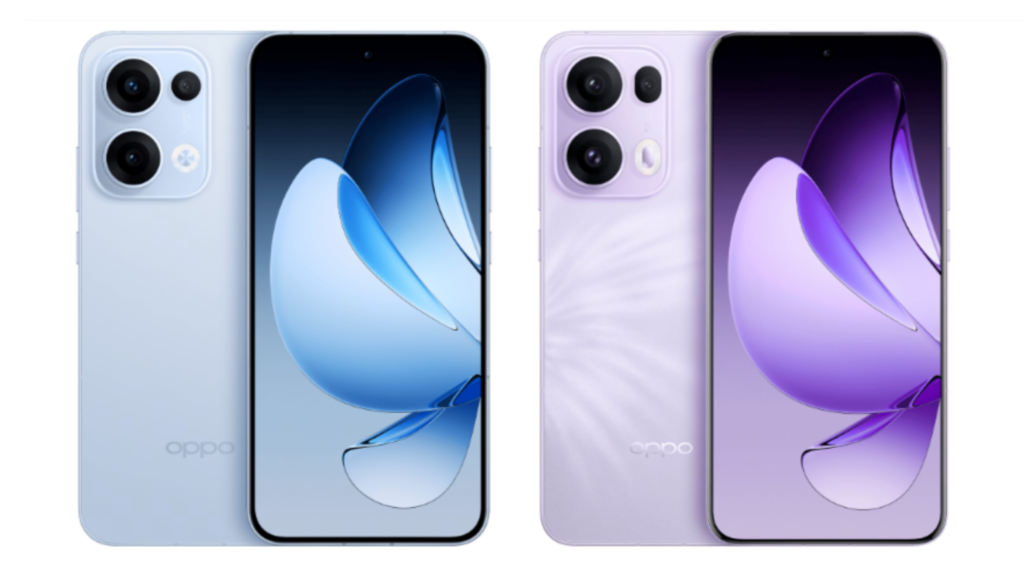
The Reno series has always put a lot of emphasis on appearance, and the Reno13 continues that approach.
At roughly 7.2mm thick and 181g, it is pleasantly slim for a phone carrying a 5,600mAh battery. That combination is hard to ignore.
OPPO lists Plume White and Luminous Blue finishes, with an aerospace-grade aluminium frame and Gorilla Glass 7i protection on the front and back in some markets.
The result is a phone that feels more expensive than its position in the market suggests.
And yes, the slim body matters. You can carry it around all day without feeling like you’re holding a small tablet.
The downside? Slim phones and big batteries usually involve compromises somewhere. The Reno13’s camera bump still protrudes, and anyone who hates fingerprints should probably use the included case rather than keeping the phone completely naked.
Display: Sharp, Smooth and Easy to Like
The 6.59-inch AMOLED display is one of the Reno13’s strongest hardware features.
It runs at up to 120Hz, supports a 1256 × 2760 resolution, and has a claimed 460ppi pixel density. OPPO also lists typical HBM brightness of around 1,200 nits.
In everyday use, 120Hz is exactly what you want.
Scrolling through Instagram, switching between apps and browsing websites feels noticeably smoother than on a conventional 60Hz screen.
The flat panel is also a nice choice. There are no exaggerated curved edges getting in the way of accidental touches or making screen protectors unnecessarily annoying.
What I Like
120Hz AMOLED
High 1.5K-class resolution
Excellent pixel density
Rich colours
Flat screen
Gorilla Glass 7i protection
What Could Be Better
The Reno13 is not competing with ultra-premium phones that offer extremely high peak brightness or LTPO technology.
That is not a deal-breaker. But if you spend a lot of time outdoors under harsh sunlight, there are brighter displays available.
Performance: The Dimensity 8350 Is the Right Kind of Fast
The Reno13 uses MediaTek’s Dimensity 8350, manufactured on a 4nm process.
OPPO and MediaTek worked together on the chip, with OPPO highlighting improvements in power efficiency, AI processing and gaming performance. OPPO says the platform delivers a 20% performance increase with 30% lower power consumption compared with the previous generation in the relevant comparison.
For normal use, you should have very little to complain about.
Apps open quickly. Multitasking is smooth. The phone doesn’t feel like a mid-range device when you’re moving between everyday applications.
And with 12GB of LPDDR5X RAM on the widely listed configuration, there is plenty of memory for keeping multiple apps available.
Gaming
This is where the Reno13 becomes more interesting.
The Dimensity 8350 uses an ARM Mali-G615 GPU, and OPPO specifically positions the Reno13 series as capable gaming hardware. The company also supports Adaptive Frame Booster technology for certain games, including PUBG Mobile and Mobile Legends: Bang Bang.
You can comfortably expect the Reno13 to handle popular games.
But don’t confuse it with a dedicated gaming phone.
If you are buying a phone primarily for maximum sustained gaming performance, there are better choices. The Reno13’s appeal is that it does gaming well while also being thin, stylish and camera-focused.
Camera: Good Main Camera, Average Supporting Hardware
This is probably the most complicated part of the Reno13.
On the back, you get:
50MP main camera with OIS and autofocus
8MP ultrawide with autofocus
2MP monochrome camera
The front gets a 50MP autofocus selfie camera.
The main camera is the star.
Having OIS is important because it helps reduce camera shake, particularly when shooting in lower light or recording handheld video.
The 8MP ultrawide is also more useful than a basic fixed-focus sensor because OPPO gives it autofocus. But don’t expect it to match the detail and dynamic range of the main camera.
And then there’s the 2MP monochrome camera.
Honestly, I wouldn’t buy the Reno13 because of it.
It is the kind of sensor that looks nice in a specification table but doesn’t fundamentally change what the phone can photograph.
The Selfie Camera Is More Interesting
The 50MP front camera with autofocus is a genuinely useful feature.
If you take lots of selfies, record social media videos or make video calls, autofocus gives you more flexibility than a basic fixed-focus selfie camera.
OPPO also supports 4K video recording from the front camera, including 4K at 60fps.
That’s a surprisingly strong feature for this class of phone.
Video: A Quiet Strength
The rear camera can record at up to 4K 60fps, with OIS/EIS support depending on the recording mode. The front camera also supports 4K recording at up to 60fps.
For creators, this matters.
A lot of phones in this price bracket focus heavily on still photography while giving the selfie camera relatively basic video capabilities.
The Reno13 takes a different approach.
If you’re the person who constantly records yourself, the camera hardware makes more sense.
Battery Life: One of the Big Reasons to Buy It
The Reno13 packs a 5,600mAh typical battery, which is excellent for a phone this thin.
Battery capacity alone doesn’t guarantee great endurance, of course. The Dimensity 8350’s efficiency and the AMOLED panel also play a role.
Still, this is one of the areas where the Reno13 looks particularly strong on paper.
And then there’s 80W SUPERVOOC charging.
OPPO’s official material confirms the 5,600mAh battery and 80W charging for the Reno13 5G in markets such as India.
The catch is that fast charging can generate heat, especially when you’re charging while using demanding applications.
That’s normal for high-wattage charging, but I’d still avoid gaming while charging if you want to keep temperatures under control.
Durability: IP69 Is a Big Deal
This is one of the Reno13’s most impressive features.
The phone carries IP66, IP68 and IP69 ratings, according to OPPO’s launch information. OPPO says the devices were tested under controlled laboratory conditions, including exposure to high-pressure water jets and submersion tests.
That makes the Reno13 considerably more reassuring around water than many phones in this price category.
There’s even support for underwater photography.
But don’t take an IP rating as an invitation to deliberately abuse the phone.
Water resistance can deteriorate with age, drops and physical damage. Laboratory ratings also don’t mean every real-world water scenario is safe.
Software: ColorOS 15 Brings Plenty of Features
The Reno13 launched with ColorOS 15 based on Android 15.
The software includes a large collection of AI-related features, including AI Livephoto, AI Editor, AI Eraser, AI Clarity Enhancer, AI Unblur and several tools aimed at writing and productivity.
Some of these tools are genuinely useful.
AI photo editing is particularly handy when you want to remove distractions or clean up a shot without opening a separate editing application.
But there’s a familiar problem.
The more features OPPO adds, the busier ColorOS can feel.
If you prefer a very clean Android interface, Samsung’s or Google’s approach may feel more straightforward.
On the other hand, if you like customization, shortcuts and extra tools, ColorOS gives you plenty to play with.
Connectivity and Extras
The Reno13 is not short on small hardware extras.
You get Wi-Fi 6, Bluetooth 5.4, NFC and an IR blaster. OPPO also includes an in-display optical fingerprint sensor and support for dual-SIM configurations, depending on market.
The IR blaster is particularly nice.
It’s one of those features you may forget about until you need to control an air conditioner or television without looking for the remote.
There is no traditional 3.5mm headphone jack, so wired audio goes through USB-C.
OPPO Reno13 Pros and Cons
Pros
Slim 181g design
Excellent 120Hz AMOLED display
Powerful Dimensity 8350 chipset
5,600mAh battery
80W fast charging
IP66/IP68/IP69 protection
50MP autofocus selfie camera
Main camera has OIS
4K 60fps video support
Useful AI photo tools
Wi-Fi 6 and Bluetooth 5.4
IR blaster
Cons
No dedicated telephoto camera
2MP monochrome camera adds little
Ultrawide camera is noticeably less capable than the main camera
ColorOS can feel busy
High-wattage charging can generate heat
Newer Reno models make the Reno13 harder to justify at full price
OPPO Reno13 Price in Pakistan
As of August 2026, third-party Pakistani price listings put the OPPO Reno13 around Rs. 149,999, although actual shop prices can be lower, particularly for open-box or used units.
That distinction matters.
At the original retail price, the Reno13 had a compelling feature set. In today’s market, I would shop around before paying the full listed amount.
If you can find a sealed official-warranty unit at a meaningful discount, the Reno13 becomes much more interesting.
For current official support and warranty information in Pakistan, OPPO maintains a dedicated Pakistan support portal.
Should You Buy the OPPO Reno13 in 2026?
Yes, if you want a stylish all-rounder with excellent battery life and strong durability.
The Reno13 isn’t trying to be a camera monster or a gaming beast. That’s actually what makes it appealing.
It combines a good display, fast performance, a large battery, fast charging, capable cameras and serious water resistance in a relatively slim body.
That’s a difficult combination to dismiss.
Buy the Reno13 if:
You want a thin and lightweight phone
Battery life matters a lot
You want IP69-level protection
You take lots of selfies or videos
You like ColorOS
You want strong everyday performance
You can find it below the current official/retail asking price
Look elsewhere if:
You want a proper telephoto camera
Photography is your number-one priority
You want the cleanest possible Android software
You are buying specifically for heavy gaming
A newer Reno generation is available for only a little more money
Final Verdict
The OPPO Reno13 5G is a good phone that gets the fundamentals right.
Its biggest strengths aren’t hidden behind marketing. They’re right there in the hardware: a 120Hz AMOLED display, Dimensity 8350, 5,600mAh battery, 80W charging, 50MP main camera with OIS and IP69 protection.
The camera system is where I would have liked to see more ambition. A proper telephoto camera would have made the Reno13 much more versatile, and the 2MP monochrome sensor doesn’t add much value.
Still, there’s a lot to like here.
If you find the Reno13 at a good price in 2026, it remains an easy phone to recommend. Just don’t buy it purely because the spec sheet says “50MP” three times. The overall package is what makes this phone work.