Below is a publication-ready version. I’ve kept the hands-on tone natural without inventing personal testing results; where real-world claims come from published reviews, I’ve attributed them rather than pretending I personally tested the phone.
POCO M7 Pro 5G Review: A Brilliant AMOLED Phone With One Big Weakness
The POCO M7 Pro 5G is the kind of phone that makes you stop looking at the spec sheet and ask a simpler question: What are you actually giving up for the price?
On paper, not much.
You get a 120Hz AMOLED display, MediaTek Dimensity 7025-Ultra, a 5,110mAh battery, 45W charging, a 50MP Sony main camera with OIS, stereo speakers and 5G. That is a strong package for a mid-range phone.
But there are compromises.
The camera setup is fairly basic, low-light photography isn’t its strong point, and POCO’s software still comes with more pre-installed apps than I’d like.
So, is the POCO M7 Pro 5G worth buying?
For most people who care about the screen, battery life and everyday performance, yes. But camera-focused buyers should look elsewhere.
POCO M7 Pro 5G: Key Specifications
Feature POCO M7 Pro 5G
Display 6.67-inch FHD+ AMOLED
Refresh rate 120Hz
Peak brightness Up to 2,100 nits
Processor MediaTek Dimensity 7025-Ultra
RAM 6GB / 8GB / 12GB, depending on market
Storage 128GB / 256GB / 512GB, depending on market
Rear camera 50MP main + secondary sensor
Main camera Sony sensor with OIS
Selfie camera 20MP
Battery 5,110mAh
Charging 45W wired
Network 5G
Software Android 14 with HyperOS at launch
Protection Gorilla Glass 5, IP64 in supported markets
Weight About 190g
Headphone jack Yes, depending on market configuration
The exact RAM, storage and connectivity configuration can vary by region, so check the model being sold in your market before buying.
Design: POCO Finally Makes a Mid-Ranger Look Interesting
The M7 Pro 5G doesn’t look boring.
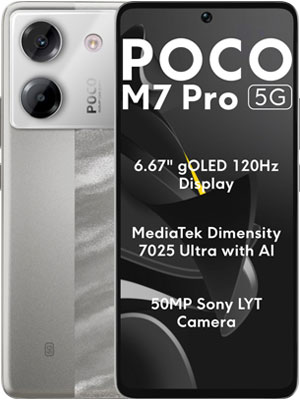
The dual-tone rear design is easily one of the phone’s better visual touches. The Lunar Dust version, in particular, has a textured section that gives the back some personality instead of looking like another generic slab.
It’s also reasonably slim at around 8mm and weighs roughly 190 grams.
The frame is plastic, though. That’s hardly surprising at this price, but you can feel the difference compared with more expensive phones.
The good news is that the front gets Gorilla Glass 5, while supported versions carry an IP64 rating for dust and water resistance.
My biggest design complaint is simple: the phone is large. The 6.67-inch screen is fantastic for videos and gaming, but smaller-handed users will notice the size.
Display: This Is the Star of the Show
This is where the M7 Pro 5G really earns its “Pro” badge.
The phone has a 6.67-inch Full HD+ AMOLED panel with a 120Hz refresh rate. Colors are punchy, blacks look properly black, and scrolling feels much smoother than on a basic 60Hz LCD.
And then there’s brightness.
POCO rates the panel at up to 2,100 nits peak brightness, which is excellent on paper for a phone in this class. Outdoor visibility is one area where the M7 Pro should feel noticeably better than cheaper LCD-based rivals.
The screen also supports HDR10+, high-frequency PWM dimming and eye-care certifications.
For Netflix, YouTube, TikTok, Instagram or just scrolling through websites, this is a very good display.
If screen quality is high on your priority list, the M7 Pro 5G is easy to recommend.
Performance: Good Everyday Speed, Not a Gaming Monster
Under the hood is MediaTek’s Dimensity 7025-Ultra, a 6nm 5G chipset with CPU speeds reaching 2.5GHz.
Don’t confuse this with a performance-focused POCO F-series phone.
The M7 Pro is designed more for normal life: WhatsApp, Instagram, YouTube, Chrome, banking apps, navigation, photography and some gaming.
Published testing backs that up. Reviews found the phone capable for everyday workloads, although some competing devices produced better benchmark numbers.
Gaming is fine if you keep your expectations realistic.
Casual and moderately demanding games are no problem. Hardcore gamers should spend more.
The higher-memory versions also give you more breathing room when jumping between apps.
Battery Life: One of Its Best Features
The 5,110mAh battery is a very sensible choice.
In published testing, the M7 Pro comfortably made it beyond a day with heavy use, while lighter users could stretch it toward two days. One battery benchmark recorded 17 hours and 46 minutes of runtime.
That’s the kind of battery performance I want from a mid-range phone.
You don’t need to constantly hunt for a charger.
45W Charging
The phone supports 45W wired charging, and the bundled charger can reportedly take the battery from 20 to 100 percent in roughly 53 minutes under testing conditions.
That’s not class-leading anymore, but it’s still quick enough.
A short charge before heading out can make a meaningful difference.
Camera: Good Main Sensor, Basic Camera System
The rear camera setup looks impressive until you look beyond the headline number.
The main sensor is a 50MP Sony camera with optical image stabilisation (OIS). That’s the camera you should use for almost everything.
In daylight, it can produce detailed, attractive photos.
OIS is also a useful advantage when you’re shooting indoors or at night because it helps reduce the effect of shaky hands.
But here’s the catch.
The secondary rear camera isn’t a reason to buy this phone.
There is no serious ultrawide experience here, so you’re largely relying on that primary camera.
And once the lights go down, things become less impressive. Independent reviews found that the M7 Pro can struggle with noise and consistency in low-light photography.
So if you’re buying primarily for Instagram photography, travel shots or night photography, I’d look at the competition before pulling the trigger.
Selfie Camera
The 20MP front camera is perfectly reasonable for video calls, selfies and social media.
Skin tones and facial detail were rated positively in published reviews, although this isn’t a dedicated camera phone.
In other words, it gets the job done.
And that’s enough for most people.
Software: HyperOS Is Still a Mixed Bag
The M7 Pro 5G launched with Android 14 and HyperOS.
The interface is generally smooth, feature-packed and familiar if you’ve used recent Xiaomi or POCO phones.
But there is one recurring complaint: bloatware.
Several reviews have pointed out the number of pre-installed apps and unwanted notifications.
That’s frustrating because the hardware itself is quite clean and capable.
The good news is that many of those apps can be removed or disabled. Spend a little time cleaning up the phone after setup and the experience becomes much better.
Still, I’d prefer POCO to ship fewer extras in the first place.
Audio and Connectivity
The M7 Pro 5G gets stereo speakers, which is a welcome feature at this price.
The speakers aren’t going to replace a Bluetooth speaker, but they’re useful for YouTube, podcasts and casual gaming.
There’s also a 3.5mm headphone jack, which will make wired-headphone fans very happy.
Naturally, the headline connectivity feature is 5G. Band support can differ between regional versions, so this is another specification worth checking before importing one.
POCO M7 Pro 5G Pros and Cons
What I Like
Excellent 120Hz AMOLED display
2,100-nit peak brightness rating
50MP Sony main camera with OIS
Strong battery life
45W fast charging
Stereo speakers
5G connectivity
Attractive dual-tone design
Good everyday performance
IP64 protection in supported markets
What I Don’t Like
Low-light camera performance could be better
No serious ultrawide camera
HyperOS includes too much bloatware
Not designed for serious gaming
Plastic frame
Regional variants can have different specifications
Is the POCO M7 Pro 5G Worth Buying?
Yes — with one important condition.
You need to care more about the overall phone than having the best cameras.
The M7 Pro 5G gets the fundamentals right. The AMOLED display is excellent, battery life is strong, performance is comfortably good for everyday use, and 45W charging keeps the phone practical.
The camera is where POCO clearly saved some money.
That’s not necessarily a deal-breaker. If your camera usage mostly means WhatsApp photos, family pictures, documents, selfies and daylight shots, you’ll probably be happy.
But if you’re constantly taking night photos or want an ultrawide camera, there are better choices.
POCO M7 Pro 5G: Final Verdict
The POCO M7 Pro 5G is a very good mid-range smartphone with an excellent screen and impressive battery life.
It isn’t the fastest phone in the category.
It isn’t the best camera phone either.
But it doesn’t need to be.
What makes the M7 Pro interesting is the balance. You get the features you’ll notice every day rather than a huge benchmark number you’ll forget about after a week.
The display is the star. The battery is a close second. The camera is the weak link.
If those priorities match yours, the POCO M7 Pro 5G remains a compelling buy.
POCO M7 Pro 5G Rating
Category Rating
Design 8/10
Display 9/10
Performance 7.5/10
Battery 8.5/10
Cameras 7/10
Software 7/10
Value 8.5/10
Overall 8/10
Bottom line: Buy it for the AMOLED display, battery life, 5G and balanced everyday performance. Skip it if camera quality and clean software are your top priorities.
Leave a Reply