POCO C81 Pro Review: Big Battery, 120Hz Display and the Big CompPOCO C81 Pro is a strange phone.
On paper, it has exactly the things budget buyers usually want: a huge 6.9-inch 120Hz display, a 6000mAh battery, HyperOS 3, expandable storage and a headphone jack.
But then you look closer.
The display is only HD+. The chipset is an entry-level UNISOC T7250. There is just 4GB of physical RAM, and charging is limited to 15W.
So, is the POCO C81 Pro a great cheap phone, or did POCO simply make a big phone with a big battery and call it “Pro”?
Let’s break it down.
POCO C81 Pro specifications at a glance
| Feature | POCO C81 Pro |
|---|---|
| Display | 6.9-inch LCD |
| Resolution | 1600 × 720 |
| Refresh rate | Up to 120Hz |
| Processor | UNISOC T7250 |
| CPU | 2× Cortex-A75 + 6× Cortex-A55 |
| RAM | 4GB LPDDR4X |
| Storage | 64GB / 128GB / 256GB UFS 2.2 |
| Rear camera | 13MP + auxiliary sensor |
| Selfie camera | 8MP |
| Battery | 6000mAh |
| Charging | 15W |
| Software | Xiaomi HyperOS 3 |
| Network | 4G LTE |
| Fingerprint | Side-mounted |
| microSD | Yes |
| Headphone jack | Yes |
| Weight | 208g |
| Thickness | 8.15mm |
These are Xiaomi’s published specifications. Memory and some connectivity features can vary by market.
Design: Big, simple and surprisingly practical
The POCO C81 Pro isn’t a tiny phone.
At 171.56 × 79.47 × 8.15mm and 208 grams, you will feel its size in your hand. That’s the trade-off for getting a 6.9-inch screen and a 6000mAh battery into a budget device.
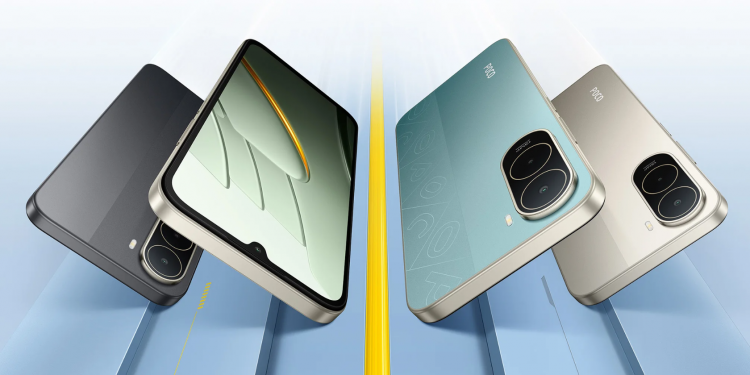
POCO offers the phone in Black, Green and Gold.
The design uses a color-block approach around the rear camera area, giving it a little more personality than the typical entry-level slab.
And I like that POCO hasn’t abandoned useful hardware just to make the phone look modern.
You still get a side-mounted fingerprint scanner, 3.5mm headphone jack and microSD expansion. Those are genuinely useful features, especially if you’re buying on a tight budget.
Display: 120Hz sounds great. HD+ is the catch.
This is probably the most interesting part of the POCO C81 Pro.
You get a 6.9-inch LCD with a refresh rate of up to 120Hz. Scrolling through social media, websites and menus should feel much smoother than a conventional 60Hz budget phone.
But there’s a catch.
The resolution is only 1600 × 720 pixels, giving you around 254 pixels per inch.
That’s low for such a massive screen.
Text won’t look as crisp as it does on a Full HD+ phone, and video won’t have the same sharpness either. The 120Hz refresh rate makes movement smoother, but it doesn’t magically make the picture more detailed.
This is the POCO C81 Pro’s biggest display compromise.
Brightness is rated at 650 nits typical and up to 800 nits in HBM, with sunlight mode available. Xiaomi also lists DC dimming and three TÜV Rheinland certifications covering low blue light, flicker-free operation and circadian-friendly use.
For outdoor use, that’s promising.
For watching movies up close, I’d rather have a smaller Full HD+ panel.
Performance: This isn’t a gaming phone
The POCO C81 Pro uses the UNISOC T7250, a 12nm octa-core chip with two Cortex-A75 cores running at up to 1.8GHz and six Cortex-A55 cores at up to 1.6GHz.
Graphics are handled by the Mali-G57 GPU.
There’s also just 4GB of LPDDR4X RAM.
POCO does offer memory extension, which can use storage to provide up to another 4GB of virtual RAM. But let’s be clear: virtual RAM is not the same thing as having 8GB of physical RAM.
For basic tasks, this setup should be fine.
- YouTube
- Web browsing
- Music streaming
- Light multitasking
- Basic games
That’s where the C81 Pro makes sense.
Heavy gaming is another story.
Don’t buy this phone expecting flagship-like frame rates in demanding games. The T7250 is designed around affordable everyday performance, not serious gaming.
And with only 4GB of actual RAM, aggressive app reloads are something I would expect when you start pushing the phone hard.
Storage: One of the better budget features
This is an area where POCO deserves some credit.
The C81 Pro comes with 64GB, 128GB or 256GB of UFS 2.2 storage, depending on the market and configuration.
You also get microSD expansion, with Xiaomi’s FAQ listing support for cards up to 2TB.
If you’re buying the 64GB version, I’d strongly recommend using a microSD card.
Modern apps are huge. Photos and videos pile up quickly. Sixty-four gigabytes can disappear much faster than you expect.
The 256GB model is the one I’d choose if the price difference is reasonable.
Cameras: Don’t expect a camera phone
Here’s another area where the “Pro” name needs to be taken with a grain of salt.
The POCO C81 Pro has a 13MP f/2.2 main rear camera with a small 1/3.06-inch sensor and an auxiliary sensor. The front camera is 8MP f/2.0.
The rear camera supports HDR, portrait mode, night mode, document mode and 1080p video at 30fps.
In good daylight, I would expect perfectly usable social-media photos.
But don’t expect flagship-level dynamic range, detail or low-light performance.
The hardware simply isn’t built for that.
And this is worth highlighting because some early third-party listings incorrectly suggested a 50MP main camera. Xiaomi’s official specification confirms that the rear main camera is 13MP.
The camera system is functional, not a reason to buy the phone.
Battery life: This is where the C81 Pro makes sense
Now we get to the phone’s strongest feature.
The POCO C81 Pro packs a 6000mAh battery.
That’s a big battery for an entry-level phone, and the combination of a relatively modest chipset and HD+ display should help it last a long time. Xiaomi claims up to 46+ hours of calling, 79+ hours of music playback and 19+ hours of video playback under its test conditions.
Real-world battery life will obviously vary.
Still, if your priorities are messaging, YouTube, browsing and calls rather than gaming, battery endurance should be one of the C81 Pro’s biggest strengths.
There is one annoying limitation.
15W charging
The battery is huge.
The charging speed isn’t.
The C81 Pro supports just 15W charging.
That means topping up a 6000mAh cell is going to take noticeably longer than it would on a more expensive phone.
So the trade-off is simple:
Excellent endurance. Slow refueling.
If you charge overnight, that’s not a big problem.
If you’re the kind of person who plugs in for 15 minutes before leaving home, it is.
Software: HyperOS 3 is a nice bonus
The C81 Pro runs Xiaomi HyperOS 3.
You get features such as Google Gemini, Circle to Search and Xiaomi’s HyperIsland interface, although feature availability can vary by region and software version. The software package is arguably more interesting than you’d expect from an entry-level phone.
But there’s a hardware concern.
HyperOS has a lot going on, and 4GB of RAM is not a lot of breathing room.
The phone may feel perfectly fine for basic use, but users who constantly jump between multiple demanding apps shouldn’t expect the same smoothness you’d get from a phone with 6GB or 8GB of physical RAM.
POCO says the C81 Pro is designed to maintain a like-new software experience for up to 48 months, based on its internal testing methodology. That’s a useful claim, but it shouldn’t be confused with a guarantee that every user will experience identical performance over four years.
Audio and connectivity
There’s some good news here.
You get a 3.5mm headphone jack, USB-C, dual-SIM support and microSD expansion.
Xiaomi also lists Bluetooth 5.2, dual-band Wi-Fi and NFC, although NFC availability can depend on the market.
The phone also has a side-mounted fingerprint sensor.
For a budget device, that’s a sensible feature list.
There is no 5G, though.
The C81 Pro is a 4G-only phone, so buyers planning to keep their handset for several years should factor that in.
POCO C81 Pro: What I like
- Huge 6000mAh battery
- 6.9-inch 120Hz display
- HyperOS 3
- microSD card support
- 3.5mm headphone jack
- Side-mounted fingerprint scanner
- Up to 256GB UFS 2.2 storage
- USB-C
- Useful AI features such as Gemini and Circle to Search
- Large screen that’s excellent for reading and casual video watching
POCO C81 Pro: What I don’t like
- HD+ resolution on a 6.9-inch screen
- Only 4GB physical RAM
- Entry-level T7250 chipset
- 15W charging feels painfully slow for a 6000mAh battery
- Cameras are basic
- No 5G
- 208g weight makes it a fairly large phone
- The “Pro” branding suggests more performance than the hardware actually delivers
POCO C81 Pro price in Pakistan
This is where you need to be careful.
Third-party Pakistani listings currently put the expected price around Rs. 49,999, but that figure isn’t something I’d treat as an official final retail price. WhatMobile currently lists the phone as coming soon in Pakistan and gives Rs. 49,999 as an expected price.
So if you’re shopping for the C81 Pro in Pakistan, check the actual local retail price before buying.
At around Rs. 50,000, the competition becomes much more important.
If the phone launches significantly cheaper, its huge battery and 120Hz screen become much easier to recommend.
If it sits close to stronger mid-range alternatives, the weak chipset, HD+ panel and 15W charging become harder to ignore.
Should you buy the POCO C81 Pro?
The answer depends heavily on what you want.
Buy it if battery life is your priority.
The 6000mAh battery, efficient entry-level hardware and huge HD+ display make the C81 Pro a sensible choice for someone who spends most of the day on WhatsApp, YouTube, Facebook, TikTok and web browsing.
Buy it if you want a big screen on a budget.
The 6.9-inch 120Hz panel is genuinely attractive at this end of the market. Just remember that it is HD+, not Full HD+.
Don’t buy it for gaming.
The UNISOC T7250 and 4GB RAM are the biggest warning signs.
Don’t buy it for photography either.
The 13MP main camera is fine for basic shots, but this is not a camera-focused phone.
Final verdict
The POCO C81 Pro is a budget phone built around two ideas: size and endurance.
Its 6.9-inch 120Hz screen is huge. Its 6000mAh battery is even better.
But POCO has cut corners to get there.
The HD+ resolution feels dated. The 4GB RAM limit is restrictive. The T7250 is firmly entry-level, and 15W charging is far too slow for a battery this large.
So I wouldn’t call this a true “Pro” phone.
I’d call it a practical big-screen battery phone.
And that’s not necessarily a bad thing.
If you understand what you’re buying, the POCO C81 Pro can be a very sensible everyday handset. Just don’t let the word “Pro” on the box convince you that you’re getting Pro-level performance.
Leave a Reply