When Apple introduced the iPhone 13, it faced a very specific challenge. Its predecessor, the iPhone 12, had successfully brought a gorgeous industrial redesign and 5G connectivity to the masses, but it suffered from one massive flaw: lackluster battery life.
The iPhone 13 was built to fix that problem entirely. Instead of chasing paper-thin aesthetic gimmicks, Apple prioritised raw, functional substance. They thickened the body slightly, packed in a massive battery, rearranged the rear camera modules diagonally to slide in a much larger sensor, and created what is widely considered the first “worry-free” standard iPhone. Years down the line, the iPhone 13 is remembered not just as a reliable device, but as the foundational blueprint that stabilized the modern smartphone experience.
1. The Real Battery Revolution
For years, iPhone users were trapped in a cycle of mid-day top-ups and battery anxiety. The iPhone 13 completely rewrote that reality. Apple managed to squeeze a much larger 3,240 mAh battery into the chassis, but the true magic lay in the efficiency of the A15 Bionic chip.
+-------------------------------------------------------------+
|                     iPhone 13 Core Benchmarks               |
+--------------------------+----------------------------------+
| Chipset                  | A15 Bionic (4-core GPU)          |
| RAM                      | 4GB LPDDR4X                      |
| Base Storage             | 128GB (Double the iPhone 12)     |
| Display Notch            | 20% Smaller than predecessor     |
| Video Playback Max       | Up to 19 Hours                   |
+--------------------------+----------------------------------+
Built on a highly refined 5-nanometer process, the A15 Bionic optimized background tasks so aggressively that the base model easily netted an extra 2.5 hours of screen-on time compared to older generations. It transformed the standard iPhone from a device you had to nurse through the evening into a genuine all-day workhorse that could comfortably survive a heavy day of navigation, photography, and streaming.
2. Professional Hardware Cascades Down: Sensor-Shift OIS
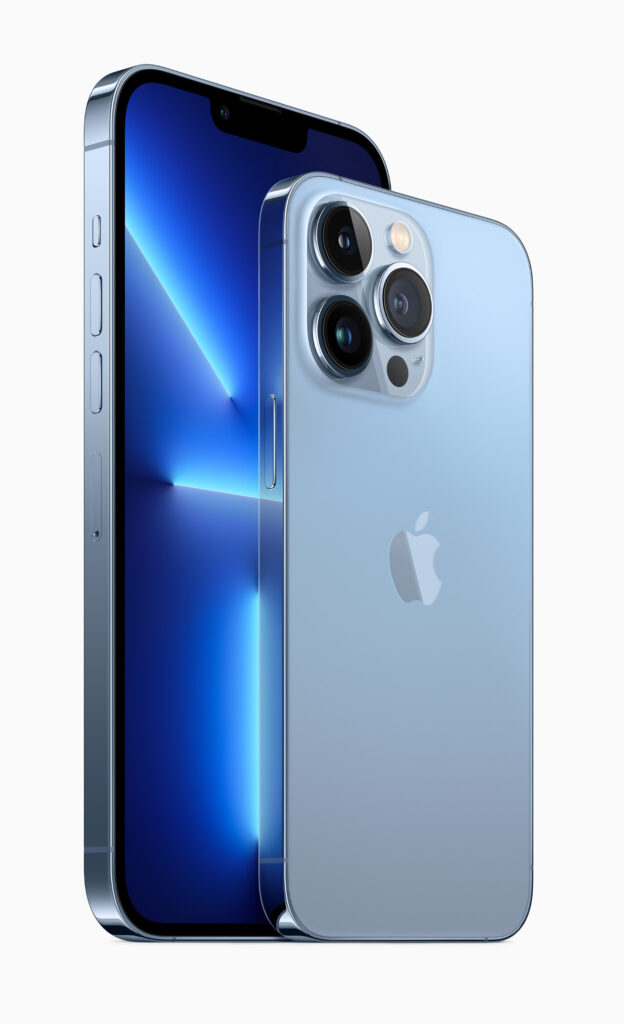
The diagonal rearrangement of the twin camera lenses on the back wasn’t a superficial style choice; it was an engineering necessity. Apple took the Sensor-Shift Optical Image Stabilization (OIS)—a breakthrough feature previously exclusive to the massive, ultra-premium iPhone 12 Pro Max—and packed it into the base-model iPhone 13.
Instead of stabilizing the lens, the phone’s internal mechanism physically moves the image sensor itself up to 5,000 times per second. For the average user, this translated into an instant leap in low-light photography. Handheld night-mode shots became drastically sharper, and walking video footage lost the jerky micro-stutters that typically plagued mid-tier phones. Combined with the debut of Cinematic Mode (which brings automatic, rack-focus depth of field to 1080p video tracking), the iPhone 13 established a baseline for mobile videography that many competitors still struggle to match.
3. Storage Parity and the Display Shrink
The iPhone 13 also corrected a long-standing consumer grievance regarding entry-level value:
- Goodbye 64GB: Apple finally killed off the restrictive 64GB baseline, doubling the starting capacity to a much more practical 128GB of base storage without raising the entry price.
- The Tighter Notch: Up front, the TrueDepth camera array was compressed, making the infamous screen notch 20% narrower. While it didn’t free up meaningful software real estate in the status bar, it gave the Super Retina XDR OLED panel a sleeker, less intrusive look during full-screen media playback.
4. The 4GB RAM Limit and Longevity
The A15 Bionic chip inside the iPhone 13 is so powerful that it actually went on to power the standard iPhone 14 a year later, meaning its processing speed easily handles standard application suites.
However, time eventually catches up to every legend. The standard iPhone 13 is equipped with 4GB of RAM. Because modern generative software architectures and heavy background multitasking demand greater memory overhead, this 4GB threshold prevents the device from entering the local Apple Intelligence ecosystem. Yet, for users who do not care about AI features, the phone’s architecture continues to deliver fluid interface transitions, secure biometric Face ID, and rock-solid cellular performance across standard modern networks.
The Verdict: A Practical Classic
The iPhone 13 is arguably one of the safest, most logical entries into the iOS ecosystem. It lacks modern luxuries like the Dynamic Island, high-refresh ProMotion screens, or a USB-C port, but it firmly compensates with exceptional structural durability (thanks to a Ceramic Shield front cover) and a battery that refuses to quit.
If you are a practical buyer looking for a highly capable, reliable daily companion that nails the absolute fundamentals of smartphone ownership—stellar call quality, brilliant display clarity, and robust video capture—the iPhone 13 stands as a historic high-water mark for Apple’s standard lineup.